
Now He’s Well Again
A tumble in the Sierras, and rehabbing with Iggy Pop and Repo Man (Jul 2026)

On my annual visit to San Francisco, I rendezvous with Rudy Fernandez, long-time concierge of members of The Clash.1 I bring a few copies of my book to sign, and he takes me out on the town. I love the benefits of a gift economy.
“So who’s this copy for?” I ask.
“Alex Cox.”
“Oh.” I pause. “Repo Man’s Alex Cox?”
“Of course!” Rudy replied. “I plan to see him in the fall.”
I took quick stock of the luminaries who have a copy of Stealing All Transmissions: A Secret History of The Clash. (Buy yours today!) :) Gang of Four’s Hugo Burnham. Fugazi’s Ian MacKaye. Bikini Kill’s Kathleen Hanna. But Alex Cox? I thought next of a line from Macklemore’s “Can’t Hold Us”:
That’s what you get when Wu-Tang raised you!
Alex Cox helped raise me—not quite from the dead in 1987, but it was only a matter of degrees.
Over the July 4th weekend, on our first summer home from college, a bunch of my buddies and older brothers drove to Twain Harte in the Sierra Foothills. We arrived in time for lunch and to tap the keg. (I was never much of a day drinker, so I had half a Solo cup’s worth of Meister Swill.) The sun excluded, less is often more in the Sierras. Nearly breezeless. Not a cloud in the sky. The air was rich with cedar and pine.
An hour later, we piled into two vans and made our way to a hiking area alongside the south fork of the Stanislaus River. It runs past the towns of Pinecrest, Cold Springs, and Long Barn, then through canyon country toward New Melones. We set off south of the reservoir at Strawberry. During summer dry spells, the spring flow turns to a near trickle, and reveals a boulder-filled river bed that at points was 35-feet wide.
In our nylon Nikes and Asics, we leapt from rock to rock. When we dropped below the height of the riverbed, a copse of ponderosa pine offered cool protection.
“I think this is it,” Greg said. “We gotta turn back.” There was, however, no turning back. Our chosen route worked well for bouncing down, not climbing out. We improvised. The first dozen steps and handholds proved simple. Then, Greg moved more deliberately, testing each foothold. I waited behind Rob as he followed Greg across an angled plane of granite. He kept his torso close to the stone.
Before he reached the next transition, Rob looked over his shoulder and said, “Put your hand here.” He slapped a trapezoidal shard at the far corner of the plane. I boosted myself up and, in slow succession, grabbed the designated hold with my right hand, bent my left knee, advanced my left foot, and hit a patch of moss.
My left foot led the way, as I slipped over the edge of the plane. I tumbled 10 to 12 feet and bounced off a boulder head first. I fell another 12 to 15 feet and landed flat on my back. I stood up, gasped for air, and blacked out.
The first thing I remembered was the shouting.
“Pull him up! Pull him up!” The voices were loud, but indistinct. “He’s sliding into the river! Pull him the f*ck up!”
A local samaritan obliged. He must have maneuvered behind me, tugged on my armpits, and got all but my feet out of the water. He sported an unruly moustache, shoulder-length hair, cut-off denims, and a cigarette between his sun-chapped lips.
“How many fingers am I holding up?” he asked.
“Two,” I said. Jesus, how I hated second-hand smoke.
“Good,” he said. “Now stay put.”
Close to an hour passed. Members of the search and rescue team appeared on the bluff above. Jim and Pete.
“I don’t see how we’re going to get down there,” Jim said.
“I think we gotta call for the chopper,” Pete replied.
“No! No helicopters!” At this point, I later learned, Rob and Greg still hoped they could avoid calling my parents. Such noble friends, indeed.
The search and rescue guys obliged. Another hour passed as they assembled a rope-and-pulley system across the gorge. Jim and Pete descended on ropes to the water’s edge with a spine board in tow.
They asked the routine questions. “Two,” I replied. It’s always two.
They looked over the matting blood near the top of my head and nodded.
“Let’s get you onto the spine board,” Jim said. “Then we’ll transfer you to the basket stretcher and shimmy you across the gorge. We’ll have an ambulance waiting for you at the top of that hill in just a little while.”
The move from the rocks to the flatboard drew my feet from the water. They were nearly numb. I watched as the basket stretcher arrived via the rope assembly. The protocol, I later learned, was to have five people in place to transfer someone from a flatboard to the stretcher. As Jim and Pete tilted the board, I felt my backside slip.
“Don’t dump me back into the water!” I shouted.
“We’re not going to dump you,” Pete scolded. “Just relax.”
(Later, my buddy John noted, “They totally almost dumped you back into the water.”)
Once I arrived on the other side of the gorge, four members of the S&R team carried me up the hill to the ambulance. Feet first. My head pounded. They loaded me into the ambulance (head first, of course), and then drove down the twisting road to Twain Harte. My head pounded some more.
“Well, you’ve got a decent sized cut near the top of your skull,” the doctor in the ER said, “but that’s well clotted at this point. Had you rotated another 5 degrees or so, you might have ended up a paraplegic. All things considered, you’re actually pretty lucky.”
My parents shook their heads. My sister looked on sympathetically. The x-rays of my back revealed nothing conclusive. Three days later, an MRI revealed two cracked transverse processes.2 The MD recommended eight weeks of no exercise beyond walking. If someone mentioned “concussion,” I didn’t remember it. And neither did anybody else.
“Here,” Katie said, on a visit to our house a couple days later, handing me a VHS tape. “I got something for you.” We didn’t have Cinemax. But Katie did, and she recorded Repo Man (1984) for me the previous afternoon.
In 1987, Repo Man was one of those things in the ether. Did someone recommend it? Possibly. Did a music critic reference it in Rolling Stone, Pulse!, or Spin? Probably. Otto Maddox, our alleged protagonist, was played by Emilio Estevez, who we all knew from The Breakfast Club (1985). The next day I cued it up and laughed a bit. Cool. Nearly two hours gone. The next day, same thing. I dug Iggy Pop’s theme song, and Otto’s response to seeing The Circle Jerks as a lounge act: “I can’t believe I used to like these guys.”
If idle hands are the devil’s playground, then idle hands, feet, and head are a fine match for the devil’s cathode tube. Before that summer, I watched the occasional movie, and caught Night Flight on the weekends, after (mostly) moderate drinking, before dozing off.
At the time, though, to the best of my recollection (the concussion notwithstanding), no one offered to pick up some books from the library. Or any magazines from Tower Records. Nor, did I initiate getting some books on my own accord. And if anyone in the family was a “big reader,” I was it. Instead, it was the summer of Otto, Harry Dean Stanton’s Bud, our dogs, and me, with the occasional visitor in the evenings.
After a week, I could walk and get around. Most of my friends had summer jobs, though, so I had plenty of morning time to kill. So I watched ever more closely. I spied the discontinuity of Otto’s first repossession: at street level, it’s a 1978 Cutlass Salon sedan. From the owner’s apartment window, it’s a 1978 Cutlass Supreme coupe. Both white. The repo men are named after American beers: Oly, Miller, Bud, and Lite. The credits roll top to bottom.
Above all else, though, it was Cox’s art of the dialogue. Snappy. Sardonic. And surprisingly memorable. (Well … not so surprising, I suppose, that after 60-odd viewings, I knew nearly every line of dialogue.) It was great to be in on the joke, but also lonely. None of my friends shared my affection for this dystopic portrait of post-industrial Los Angeles, which fit beautifully with our barely tempered affection for San Francisco.
“It’s a beautiful night out tonight. You can almost see the stars.”
—Bud
Upon my fall arrival at UC Santa Barbara, I was basically healed. I had the occasional bout of vertigo while playing volleyball, but that was it.3 The following year, I shared a room with Jerry in an oceanside three-bedroom apartment. We were acquaintances through work, then roommates, then eventually dear friends. (See this OTM essay for more on Jerry.)
One night that fall, while deciding where to eat in Isla Vista, Jerry cocked his head, smiled wide, and quipped, “‘Let’s go get sushi. And not pay.’” A minor line. By a minor character. (Duke, played by Dick Rude.)
It’s the minor characters, though, who get the best lines in the film. Namely, Miller, in his blue mechanic coveralls, who schools Otto over and over. “Find one in every car,” he says, holding the evergreen-shaped air freshener that hangs from rearview mirrors across the city. “You’ll see.”4
That night, I waited. On our walk home, a mid-70s Camaro passed, blasting Poison’s “”Nothin’ But A Good Time.”
“‘The more you drive,” I said flatly, “‘the less intelligent you are.’”
Jerry laughed and nodded. The exchange kickstarted a love language we would visit weekly, then episodically, for close to 35 years.
It was affectionate and competitive. Over the years, infrequency and poignancy added value. The rarer and sharper the quip, the better. The banter, though, was not simply performative or nostalgic. For Bud, the credo was simple:
“An ordinary man spends his life avoiding tense situations. A repo man spends his life getting into tense situations.”
Did we embrace the Repo Man code? On our mountain bikes, fairly often. On our road bikes, sometimes. Into our early 20s, when it came to risking the rejection of women: once, maybe twice, in a blue moon. Still, we spent our money on vinyl and concert tickets by independent bands, tried to avoid supporting the worst corporations (Dow Chemical, the oil companies), and convince ourselves that our circle of friend was forging a life less ordinary.
Cox helped resurrect Iggy Pop, too. In 1983, Cox tracked down Pop in an unfurnished efficiency apartment, just up the hill from the Whiskey-a-Go-Go. As Pop recalls, he shared the space with “a Japanese girl who couldn’t speak English, a futon, and a Stratocaster guitar.”
[Alex] was a very large young British guy with not particularly great British manners. He explained to me about the film he was making. He said, “I want you to do a song for me, do what you want” . . .
I’ve done a lot of this kind of work since, and it’s very rare that for something as finance-intensive as a film that anyone will give you a carte blanche opportunity like that.5
Pop made the most of the opportunity. He enlisted ex-Pistol Steve Jones on guitar, and Blondie’s Nigel Harrison on bass and Clem Burke on drums. It begins as a 12-bar blues, with spiky riffs in the bass. It takes a novel excursion, though, along the V, VI, VII, and IV chords, when Pop’s voice rises through the line, “I’ll turn you into a toadstool.”
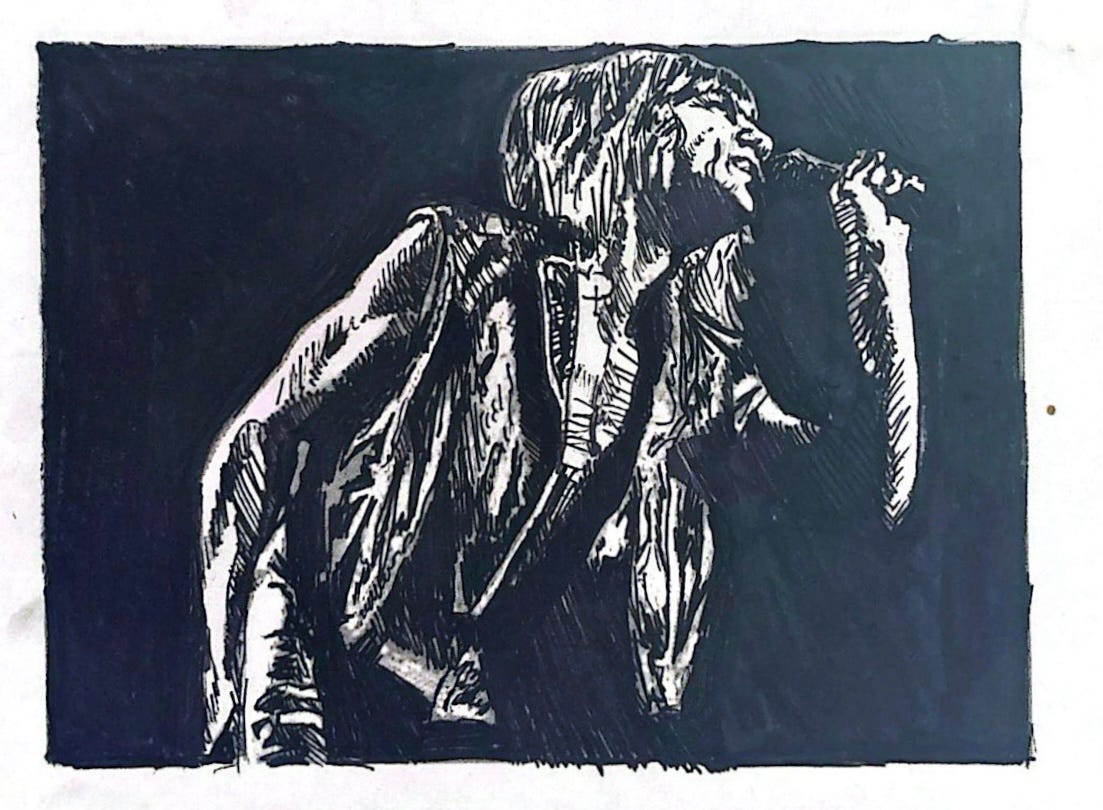
Iggy Pop with covered torso (drawing by @deathbydisco_).
The images in the lyrics seem to be culled from a night in front of the TV, with the Hamlin wired remote control on Iggy’s lap, sliding from station to station.
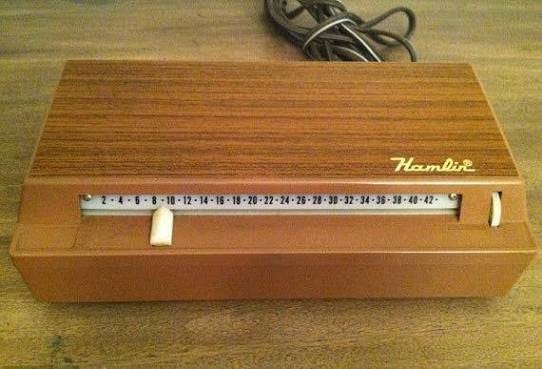
The Hamlin. (Look at all those channels!) (Photo credit: unknown).
There’s a page torn from a comic book. A chicken on a hook. A babbling brook and a TV cook.
Its mix of the blues and collage-like stanzas is a fitting herald of another punk-pop icon: Los Angeles’ Beck, who released Banjo Story, his first mix tape, in 1988.6
For Pop, that visit from Cox was fundamental. “It was like a gift from God to express myself. It was just wonderful.”7 And, with “Repo Man,” Pop returned the favor to Cox, executive producer (and original Monkee) Michael Nesmith.
The film opens and closes with Iggy Pop’s “Repo Man”: the instrumental version and the single version, respectively. Only the latter appears on the soundtrack, which played no small part in the film’s success.
In 1984, in relatively quick succession, Repo Man had an underwhelming opening in February, the soundtrack sold 50,000 copies by August and, soon after, the film was re-released to critical acclaim (and a decent box office).
A lifetime later, my daughter and I were out for a drive, and the randomly selecting CD player cued up Iggy Pop’s “Passenger.” From the backseat, about 30 seconds in, K. asked, “Does this song have any lyrics?”
I laughed. In the rearview mirror, she flashed me a quizzical look.
At three years old, she was already making grammatical sense of the love language of pop.
Thank you for reading One Track Memory. If a friend shared this essay, you have an adorable friend.
To get OTM in your inbox ahead of everybody else, click the button below.
🐔🪝,
Randal
# # #
See Pat Gilbert’s Passion is a Fashion: The Real Story of The Clash. London: Aurum Press, 2011, pp. 246, 255-256.
“The transverse processes are two bony projections extending outward from the sides of each vertebra in the spine. They act as vital attachment points for muscles and ligaments, serving as leverage levers that allow the spine to bend, rotate, and maintain posture.” Hak-Jin Kim. 2010. “Radiologic Anatomy of the Spine.” Minimally Invasive Percutaneous Spinal Techniques, 46–57. https://doi.org/10.1016/b978-0-7020-2913-4.00003-3.
In doubles, if the ball was set slightly behind me, and I tilted my head back, the vertigo would kick in. After 3 to 4 minutes with my head between my knees, I’d resume playing.
“Otto is a blank page,” Cox noted. Joseph B. Atkins. 2020. Harry Dean Stanton: Hollywood’s Zen Rebel. Lexington, KY: University Press of Kentucky, p. 120.
Criterion. 2013. “Iggy Pop on Meeting Alex Cox and Repo Man.” YouTube. www.youtube [dot] com/watch?v=3LqgT4pirAQ.
2026. “Banjo Story.” Beck Wiki. Fandom, Inc. https://beck.fandom.com/wiki/Banjo_Story.
Criterion. 2013.